- ✓Shots inside 100 meters decide whether you get birdie chances or save par.
- ✓Practice with varied height and spin, not just full swings.
- ✓Add pressure to your practice. That's where the shots have to hold up.
Why wedge play?
Every spring, the golf world is glued to the TV for the first major of the season. The flowers, the fast greens and the approach shots that stop a meter from the flag.
We don't get to play there. But we can practice the shots that make it possible. Here are four drills in tribute to that kind of golf.
1. Precision from 80–100 meters
This is scoring distance. From here the ball should find the green, ideally close.
Use the grass range if there is one. Hit to a practice green with different wedges, from pitching wedge to lob wedge. Vary the height. Note where the ball lands and how far it rolls. After a couple of sessions, you'll know exactly how far each club goes.
2. Precision under pressure
On TV it looks easy. It isn't when something's on the line.
Set targets in tough spots around the practice area. Add imaginary water in front of the green and bunkers on the sides. Hit ten shots and keep score. Miss on the wrong side and you lose a point. The goal is to train your composure as much as your technique.
3. The low spinner
A low, punched wedge is one of the most useful shots there is. It works in wind, under branches and when the green slopes away from you.
Play the ball slightly back in your stance. Hit down with your hands ahead of the ball and keep the finish short. The ball should come out low, hop once and stop. It takes time to learn. It's worth it.

4. The high wedge
Fast, sloping greens call for a shot that lands soft. Get out your 58 or 60 degree.
Open the face, let the club slide under the ball and commit to accelerating through it. Practice from different lies: tight lies, rough and slopes. It's the shot that saves par when everything else has gone wrong.
"It's the details that do it. Especially inside 100 meters."
Stripe Golf
The clock system for distance control
The simplest way to control your wedges is to use the same swing with different backswing lengths. Picture yourself standing in the middle of a clock face.
- Nine o'clock: Left arm parallel to the ground (for right-handers). The shortest shot.
- Ten o'clock: A bit longer. Often the most useful shot from around 50–70 meters.
- Full swing: All the way. Your max distance with each wedge.
Hit ten balls with each length and each wedge. Write down how far the ball carries. Three wedges and three swing lengths give you nine distances you can trust.
Bounce and sole
Bounce is the angle between the wedge's leading edge and the sole. More bounce helps the club skid through sand and soft turf instead of digging in. Less bounce suits firm ground and players with a shallow swing.
Play mostly on soft courses, or have a steep swing? Go with more bounce. Play on firm courses? Less. Many players carry one of each.
A 45-minute wedge session
-
1
The clock system (15 min)Run through your nine distances. Note anything that's changed since last time.
-
2
Varied targets (15 min)Change target and club every shot. 40, 75, 60, 90 meters. Just like on the course.
-
3
Tough lies (10 min)Hit from rough, slopes and tight lies. That's where you'll use your wedges most.
-
4
Pressure round (5 min)Ten balls, ten different distances. Count how many land within five meters of the target.
Keep stats
After every round, note how many approach shots you had from 100 meters and in, and how many found the green. Also note roughly how far from the flag they finished.
After a month, you'll know whether you mostly miss short, long or to the side. Then you know exactly what your next session should be about.
Look after your grooves
The grooves on your wedge put spin on the ball. Dirt and grass in the grooves make the ball slide instead of grip. Wipe the clubface with a damp towel between shots. It's a small habit that makes a difference on short shots.
Wedges in the wind
Into the wind, high wedges fly shorter and less predictably. Take one more club and swing easier. A lower ball flight is usually safer.
Downwind, the ball lands softer but rolls farther. Aim short of the flag and let it run up. The low spinner from drill 3 comes in handy either way.
Frequently asked questions
How many wedges do I need?
Most players do fine with three: a pitching wedge, a gap wedge around 50–52 degrees and a sand or lob wedge around 56–60 degrees.
How do I practice distance control?
Use the same swing with different backswing lengths, for example to hip height, shoulder height and full. Measure how far each one goes.
Do I need a rangefinder to practice wedges?
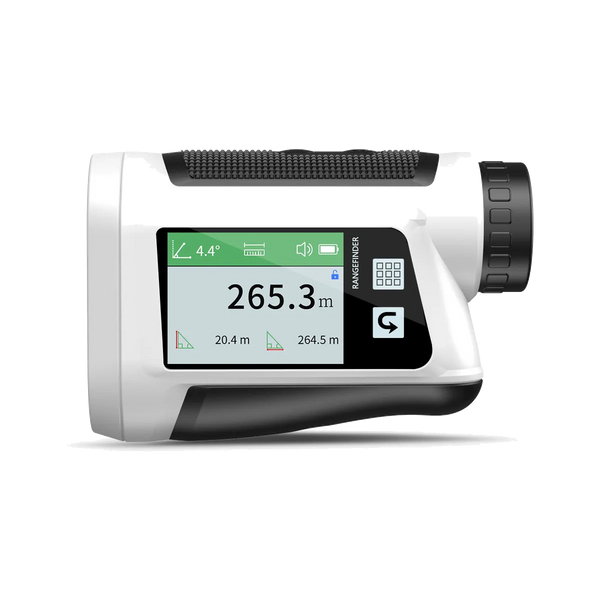
Knowing the exact distance to the target helps. A rangefinder makes it easy, even on the range.
Why don't my wedge shots spin?
Common causes are dirty grooves, a firm ball or striking the ball too high on the face.
How often should I replace my wedges?
Grooves wear out. If you play a lot, it can be worth replacing your most-used wedge more often than your other clubs.